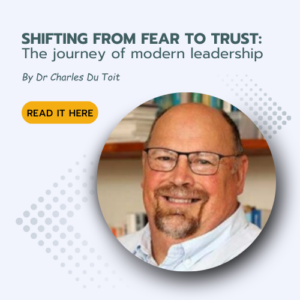
Trust‑Based Leadership: The Superpower for Modern Teams
.
In today’s volatile and fast‑changing business environment, traditional KPI‑driven leadership is no longer enough. Organisations are discovering that sustainable success depends not on control, but on trust. Dr. Charles du Toit’s Trust‑Based Leadership Trilogy offers a blueprint for leaders who want to move beyond compliance and cultivate truly high‑performing teams.
Trust as the Core Currency
The trilogy begins with the 9 Principles of Trust‑Based Leadership, which establish trust as the foundation of influence. Principles such as self‑awareness, authenticity, empathy, transparency, and accountability remind leaders that credibility is earned through consistent, relational actions. Without trust, strategy, innovation, and cultural initiatives struggle to take root. Trust is the currency that unlocks engagement and loyalty.
Leadership in the Moments That Matter
The 14 Commandments, translates philosophy into practice. It recognises that leadership is tested not in grand speeches but in everyday “Leadership Moments”; how leaders respond to conflict, mistakes, accountability, and recognition. Simple yet powerful commandments such as Don’t Walk Past, Hold Team Members Accountable, and Be Generous in Your Appreciation provide leaders with actionable guidance. These practices build credibility in the micro‑interactions that shape culture. The ability to handle these moments with integrity and empathy is what differentiates resilient leaders from transactional managers.
Building Teams with Superpowers
This book bridges leadership theory with organisational design. It argues that ordinary teams deliver KPIs, but extraordinary teams, “superpowered teams”, are autonomous, collaborative, and purpose‑driven. The book introduces eight leadership levers that enable intrinsic motivation: trust, clear roles, diversity, shared norms, co‑created vision, competence, learning culture, and calibrated autonomy. These levers align with the needs of the Fourth Industrial Revolution, where agility, innovation, and human connection are paramount.
As the author notes: “People perform best when work matters to them. Leaders can’t create intrinsic motivation directly, but they can create conditions for it.” This insight is crucial in a business world where burnout and disengagement are rising threats.
Why It Matters Now
The importance of trust‑based leadership has never been greater. Organisations face unprecedented disruption: technological shifts, global competition, and evolving employee expectations. Command‑and‑control models erode morale and stifle innovation. In contrast, trust‑based leadership empowers people to take ownership, collaborate across diversity, and sustain energy in the face of change.
For CEOs and HR leaders, embedding trust into organisational DNA means recalibrating recruitment, onboarding, performance management, and leadership development. Culture change is not a campaign; it is a sustained commitment. As this trilogy makes clear, leadership is influence, not control. When leaders create the right environment, teams evolve from functional to extraordinary.
Trust‑Based Leadership is not a soft skill; it is a strategic imperative. By embracing the 9 Principles, practicing the 14 Commandments, and applying the frameworks in Building Teams with Superpowers, leaders can unlock the intrinsic motivation that transforms ordinary teams into superpowered ones.
Trust is no longer optional, it is the superpower that drives resilience, innovation, and long‑term success.
Click Here to move the dial from ‘good’ to ‘GREAT’✨
READ THE ARTICLE HERE:
 Loading...

 Reload document
  Open in new tab
 Get in touch with us here **
#BuildingTrust #TeamSuccess #TrustBasedLeadership #LeadershipGoals